

Updated Sept/2026
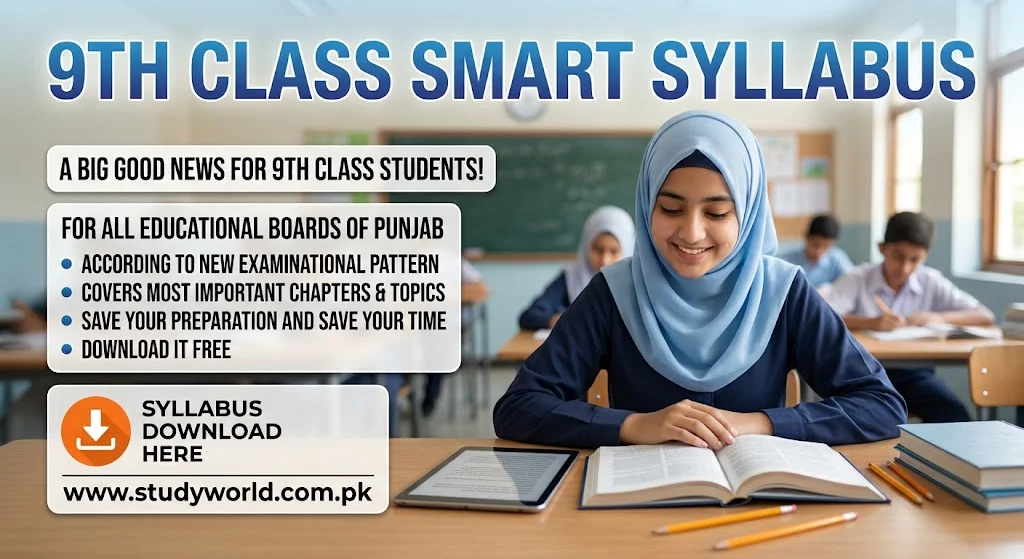
Preparing for the 9th Class annual examinations requires a cohesive and focused strategy, which is why following the 9th Class Smart Syllabus 2026 is essential. This Accelerated Learning Program serves as a vital guide for students across all educational boards in Punjab by outlining condensed portions of the curriculum, key chapters, and specific topics required for the upcoming board examinations.
This guide offers a detailed overview of the syllabus structure and subject specific information, while also providing direct guidance for effective exam preparation.
What is the 9th Class Smart Syllabus for 2026?
The Smart Syllabus for the 9th Class is a specially curated curriculum developed by the Punjab Curriculum and Textbook Board (PCTB) to enable students to focus on key and fundamental educational concepts. Instead of covering unnecessary supplementary material, this specific syllabus concentrates on important exercises, short and detailed questions, and practical work.
Key Benefits for Students
- Targeted Preparation: Concentrates exclusively on board-oriented topics.
- Reduced Exam Stress: Eliminates unnecessary sections, allowing deeper focus on critical subjects.
- Clarity on Paper Pattern: Aligns directly with the latest paper scheme and model papers for 2026.
Subject Wise 9th Class Smart Syllabus 2026
The subject wise smart syllabus of 9th class are following below:
1. Mathematics (Science Group)
- Algebra & Equations: Focus on essential exercise questions in Unit 1 (Matrices), Unit 2 (Real & Complex Numbers), and Unit 4 (Algebraic Expressions).
- Geometry & Theorems: Specific theorems from Chapter 12 and Chapter 16, alongside selective review exercises.
2. Physics
- Core Units: Fundamental physical quantities, kinematics, dynamics, and thermal properties of matter.
- Numerical Problems & Conceptual Questions: Selected numericals from each chapter’s exercise end-notes.
3. Chemistry
- Key Topics: Fundamentals of Chemistry, Structure of Atoms, Periodic Table, Chemical Bonding, and Electrochemistry.
- Practical & Theory Focus: Short definition-based questions and primary chemical reactions.
4. Biology / Computer Science
- Biology: Cell biology, bioenergetics, nutrition, and transport systems with selective diagram-labeling questions.
- Computer Science: Problem-solving techniques, introduction to programming concepts, and digital logic gates.
5. Compulsory Subjects (English, Urdu, Islamiat, Pak Studies)
- English: Selected translation paragraphs, targeted grammar exercises (active/passive voice, direct/indirect), and specific comprehension passages.
- Urdu: Selected Sabaq, Nazam, and Ghazal summaries, along with essential grammar (Khatoot, Kahaniyan).
- Pak Studies & Islamiat: Core historical events, constitutional history, selected Quranic verses (Aayat), and target Ahadith.