

Updated Sept/2026
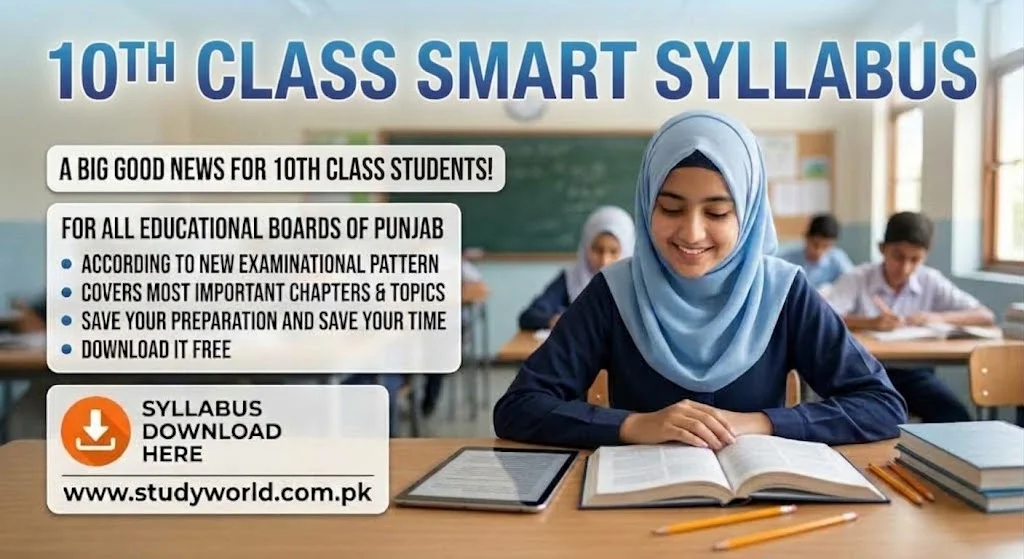
Scoring top marks in the 10th Class Board Examinations 2026 demands a structured revision plan and precision study. The 10th Class Smart Syllabus 2026, framed under the Accelerated Learning Program (ALP) by the Punjab Curriculum and Textbook Board (PCTB), serves as an indispensable framework for matriculation final exams.
This comprehensive guide breaks down the updated course outline, key high yield topics, and subject wise exam preparation strategies tailored specifically for 10th Class students.
10th Class Smart Syllabus 2026
The 10th Class Smart Syllabus is engineered to streamline final exam preparation by removing redundant sections and highlighting core concepts, primary long questions, essential numerical problems, and mandatory practicals.
Strategic Advantages for Matric Students
- High-Yield Course Outline: Directs student focus to high-frequency board questions.
- Streamlined Final Revision: Reduces subject overload, making multi-subject revision manageable before annual exams.
- Aligned with Board Schemes: Fully synced with the latest 2026 paper pairing schemes across all Punjab educational boards.
Detailed Subject-Wise Breakdown (10th Class)
1. Mathematics (Science Group)
- Quadratic Equations & Variations: Essential questions from Unit 1 (Quadratic Equations), Unit 2 (Theory of Quadratic Equations), and Unit 3 (Variations).
- Trigonometry & Practical Geometry: Selected problems from Unit 7 (Introduction to Trigonometric Formulas), along with practical geometry circles and construction theorems from Chapter 13.
2. Physics
- Waves & Optics: Focused study on Simple Harmonic Motion (Chapter 10), Sound Waves (Chapter 11), and Geometrical Optics (Chapter 12).
- Electromagnetism & Electronics: Key concepts from Electrostatics (Chapter 13), Current Electricity (Chapter 14), and Basic Electronics (Chapter 17) along with target numerical problems.
3. Chemistry
- Organic & Environmental Chemistry: Core concepts of Chemical Equilibrium (Chapter 9), Organic Chemistry basics (Chapter 11), Hydrocarbons (Chapter 12), and Environmental Chemistry (Chapters 14 & 15).
- Reaction Kinetics & Practicals: Essential short definition-based questions, functional groups, and primary chemical tests.
4. Biology / Computer Science
- Biology: In-depth focus on Homeostasis (Chapter 11), Coordination & Control (Chapter 12), Inheritance (Chapter 15), and Biotechnology (Chapter 17) with diagram exercises.
- Computer Science: C-Language / Python programming fundamentals, Control Structures, Arrays, and Function syntax practice.
5. Compulsory Subjects
- English: Important translation paragraphs, essential essay topics, direct/indirect speech rules, and specific pair of words.
- Urdu: Selected Sabaq summaries, Nazam and Ghazal explanations, formal application/letter writing, and essay grammar.
- Pak Studies & Islamiat: Post-1971 political history, foreign policy of Pakistan, economic development, and targeted Quranic verses (Aayat) and Ahadith with translation.